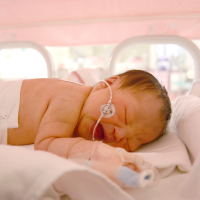
If you had a pre-term birth, or your baby needed special medical care in a neonatal intensive care unit (NICU), this may have been a traumatic experience for you as a parent.
Understandably, going through this experience with your child can affects future pregnancies.
If you are thinking about what might happen if you have another baby, I’m going to talk you through some things that can help.
Recognising the impact of a NICU experience
Experiencing your baby needing intensive medical care (whether for a short, acute time, or a lengthier stay) can be a deeply challenging start to parenthood. Many parents describe their experience of NICU as ‘scary’, ‘intimidating’ and ‘overwhelming’ (Chen et al. 2022) and over a third will describe it as traumatic (Schecter et. al. 2019).
In a survey by UK charity Bliss, 80% of parents reported that their mental health got worse after their time on the neonatal unit and about 15% of parents develop PTSD after NICU experience (Schecter et. al. 2019).
Even if many months have passed since your baby was home and you are all doing well, the feelings and fears connected to your NICU experience can all come back up again when you are preparing to have another baby.
I want you to know that your feelings about this makes sense. Pregnancy and birth are things we can’t fully control, no matter how hard we prepare. It can feel hugely challenging to actively going towards another birth when your last had elements that were really difficult for you, your partner or your child.
So what can help you cope when it comes to pregnancy after NICU?
What will help you is going to be really individual, but here are some of the things that the families I work with find most useful.
Figure out what you might need to feel safe in pregnancy
This is so individual, as every single parent I work with needs something slightly different when it comes to feeling psychologically safe in pregnancy and birth. It can help to shut out the noise (other people’s ideas), look back and reflect on your previous experience of birth and NICU.
You may find it helpful to work with a professional to understand and make sense of what happened at the birth, especially if there were some factors that might have affected your baby’s need for specialist care.
If there are specific medical fears or risks for you, you can talk to your provider about seeing a specialist, like a maternal-fetal medicine specialist, who is trained to care for women who are at risk for having pregnancy complications.
You might find that what helps you feel safer is knowing that these risks are being managed differently this time. Perhaps that might involve extra appointments, scans or tests; certain medication, or a birth plan that is designed to reduce certain complications from happening.
Find your voice
It’s so important to feel that you understand the risks as they apply to you and then to feel involved in making decisions about how to manage those risks.
Being involved in the decision-making often helps parents feel a bit more in control during pregnancy.
I always encourage parents to build their confidence to ask questions, really get information on this from specialist. No question is wrong or silly! You deserve to know any information they can give you about the reasons your baby was born premature or unwell, what the risks are in this pregnancy and what extra things can be put in place.
By finding your voice, you can ask about anything that is worrying you and then benefit from all their knowledge and experience as you make the decisions about your next pregnancy and birth.
Write a trauma-protective birth plan
Your birth can be so much more than a piece of paper. A trauma-protective birth plan has an extra focus: communicating your last experience of birth, your fears and concerns and includes a plan to manage those. (I have a class on how to write your own trauma-informed birth plan here). If you do this, your birth plan can be a valuable tool, highlighting this key information for anyone who ends up being involved in your birth, and ultimately leading to better care, better support and better communication.
Focus on what you do control
The difficult thing about birth is that there will always be factors we don’t control. We can do all the preparation and still have to cope the uncertainty of birth. I talk a lot about what can help us ‘tolerate’ this – because you don’t have to love it, but you can learn to tolerate it.
One thing that helps? To keep coming back to focus on what you can control, which often comes down to having choices, and feeling equipped and empowered to make the decisions that are right for you.
Get as much support as possible for the anxiety that will be around!
I always bring this back to figuring out what works for you – that might be therapy (ideally with a perinatally trained clinician), or it might be extra support from your friends and family, or through doing yoga, meditation, dance, massages…
I know how much it helps in pregnancy to have some tools you can easily reach for, so you know how to respond to what if thoughts or waves of anxiety in your body. This is something I teach a lot of inside my Better Birth program, as knowing how to regulate nervous system is so powerful for both pregnancy and birth.
Plan for postpartum
One thing about having been through NICU before is that you now have a much more detailed understanding of what it involves, and what it might feel like. This is information you can use to plan out what you might need if your next baby were to need some additional medical care.
This plan can include practicalities like organising care for your older children, meals and laundry; specialist breastfeeding support; or including certain items on your hospital bag checklist just in case. Think about your mental health here too – what supports might you need in place for YOU? And what about your partner?
Remember that every pregnancy is different – and you are different now too.
As hard as it is, it can help to remind yourself every day that no two pregnancies are the same. This is a new pregnancy, with new possibilities. It is okay to hold hope as well as fear – try to make room inside yourself for both. And remember, you are also going to be different this time – you are already a mum, and can bring everything you have learnt from your previous experience to help you cope this time around.
Dr Rosie Pajak is a perinatal clinical psychologist and founder of the Birth Healing Collective. She offers specific support and resources for parents preparing to birth again after difficult birth experiences through The Better Birth Program.
References
Chen MJ, Kair LR, Schwarz EB, Creinin MD, Chang JC. Future Pregnancy Considerations after Premature Birth of an Infant Requiring Intensive Care: A Qualitative Study. Womens Health Issues. 2022 Sep-Oct;32(5):484-489. doi: 10.1016/j.whi.2022.03.004. Epub 2022 Apr 28. PMID: 35491347; PMCID: PMC9532354. https://www.ncbi.nlm.nih.gov/pmc/articles/PMC9532354/